
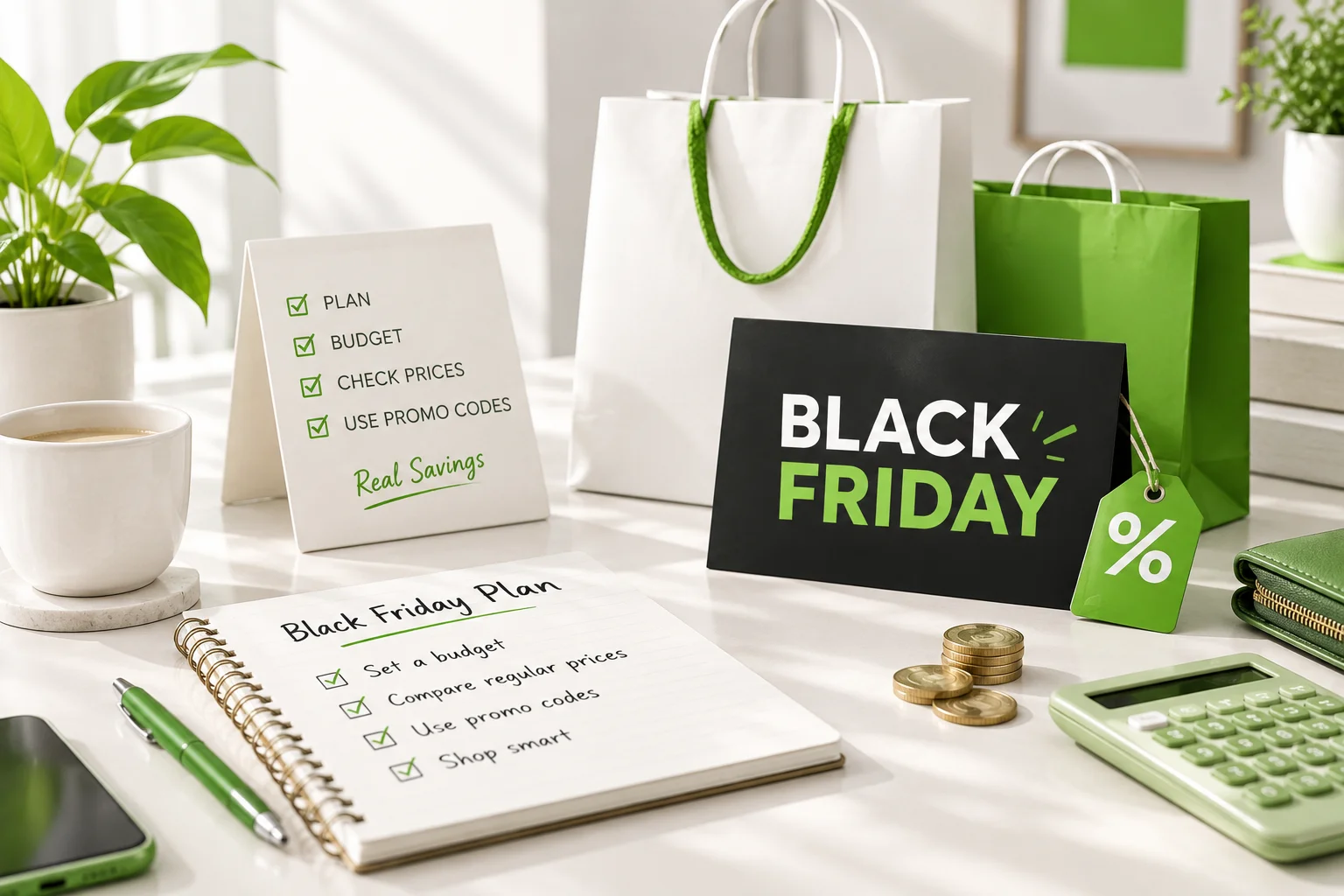

Black Friday promises big discounts, but a low price tag doesn't always mean you're saving money. Some "deals" are only slightly better than a normal week, and some purchases are things you never planned to buy. If you want to know how to save on Black Friday, the answer is mostly preparation: decide what you need, learn what it usually costs, and check for extra savings before you pay.
This guide covers the dates to know, a step-by-step plan, and the mistakes that quietly eat into your savings.
Direct Answer: The Short Version
The shoppers who save the most on Black Friday tend to do five things:
- Make a list of what they actually need, with a budget.
- Learn the normal price of each item before the sale starts.
- Shop in the right window instead of the first hour.
- Check for promo codes, cashback, and sitewide offers before checkout.
- Compare the final price, including shipping and taxes, across stores.
Everything below expands on those five habits.
Know the Dates First
In 2026, Black Friday falls on Friday, November 27, the day after US Thanksgiving on November 26. Cyber Monday follows on Monday, November 30.
Many retailers no longer keep their deals inside that window. Early sales often start in the first part of November, and some offers run into the first week of December. That gives you more time to compare prices, but it also means "Black Friday" is now a season, not a single day.
Build a Black Friday Shopping Plan
Start with a list and a ceiling
Write down the items you were already planning to buy, such as a laptop for work, winter boots, or gifts for specific people. Next to each one, set the most you're willing to pay. A sale price only counts as a saving if you'd have bought the item anyway.
A budget also protects you from impulse buys. Sale pages are designed to make everything look urgent, and a written limit is an easy way to slow down.
Learn the regular price
You can't spot a good deal without knowing the baseline. In the weeks before the sale, check the current price of each item on your list at two or three stores. Note it down or use a price-tracking tool or browser extension if you like.
This also exposes inflated "original prices." If a product's usual price is $80 but the sale page shows a crossed-out $120, the real discount is much smaller than advertised.
Shop in the right window
Timing matters more than most people expect. Early deals can be good for popular items that sell out, while later sales sometimes bring deeper cuts on leftover stock. Some categories tend to be stronger on Black Friday itself, and others on Cyber Monday. Since sales calendars shift from year to year, treat any pattern as a guideline rather than a rule.
For a fuller look at when to buy and when to hold off, see our guide on timing purchases to save.
Practical Tips to Save More
1. Check for promo codes before you pay
A sale price and a promo code are separate things. Some stores let you apply a code on top of a Black Friday discount, while others exclude sale items. Before checking out, it's worth looking through the current Black Friday deals and any store-specific codes to see whether something applies to your cart. Always read the terms, because a code that works on full-price items may not work on clearance.
2. Sign up for retailer emails early
Many stores send early-access offers or one-time welcome discounts to new subscribers. Use a separate email address for this so your main inbox doesn't fill up, and unsubscribe once the season ends.
3. Compare the total cost, not the sticker price
A cheaper item with paid shipping can cost more than a slightly pricier one that ships free. Compare the final amount at checkout, including:
- Shipping fees and delivery speed
- Sales tax
- Return shipping costs
- Any membership required to get the price
4. Understand the return policy
Holiday return windows vary by retailer, and some items, such as certain electronics or final-sale products, have stricter terms. Check the policy before buying anything expensive. A good price is less valuable if you're stuck with something that doesn't work for you.
5. Use cashback or rewards carefully
Cashback programs and credit card rewards can add a small extra return. They only help if you'd pay off the balance anyway. Interest on an unpaid card balance can erase any savings quickly.
6. Watch for bundles and gift cards
Some retailers offer a gift card or accessory with a purchase instead of a direct discount. That can be good value if you'd use the gift card, but it's not the same as money off. Do the math on what you'd really spend.
7. Buy ahead only for things you'll use
Black Friday is a good time to stock up on items you use regularly and that don't expire, like household basics or winter clothing you already need. Buying ahead makes less sense for things that go out of style or that you might not use.
8. Set a cutoff for Cyber Monday
It's tempting to keep shopping for four straight days. Decide ahead of time which purchases you'll make on Black Friday and which you'll wait on until Cyber Monday, then stop when your list is done.
9. Protect yourself from fake offers
Shopping surges attract scam sites and misleading ads. Stick to retailers you recognize, be cautious with deals that look too good to be true, and avoid sites that ask for payment methods you can't dispute. Paying by credit card generally gives you stronger dispute options than a debit card, though protections vary by issuer.
A Simple Example
Say you want a pair of wireless headphones and you've watched the price for a few weeks. They usually sell for around $150. On Black Friday, Store A lists them at $119 with $8 shipping, and Store B lists them at $125 with free shipping and a 10% code for new subscribers.
Store A totals $127. Store B, after the code, comes to about $112.50. The lowest sticker price wasn't the lowest real price. Without a baseline and a quick check for codes, it would be easy to choose the wrong one.
Common Mistakes to Avoid
- Buying because of urgency. Countdown timers and "only 3 left" messages are built to rush you. If you have a price baseline, you can judge the deal calmly.
- Trusting "up to" discounts. "Up to 70% off" only tells you the best-case item, not what's typical across the sale.
- Skipping the fine print. Exclusions, minimum spends, and expiry dates decide whether a code or offer applies to you.
- Ignoring your budget. Many small discounted purchases can add up to more than one planned purchase.
- Forgetting about price changes. Some prices drop further after Black Friday, and some fall back up. Knowing the normal price helps you decide.
Frequently Asked Questions
When is the best time to shop for Black Friday deals?
There isn't one best time for every product. Early sales suit items that sell out fast, while Black Friday weekend and Cyber Monday often bring wider selection. Tracking the price of your specific items in advance helps you pick your moment.
Can I use a promo code on top of a Black Friday sale price?
Sometimes. It depends on the retailer's terms. Some allow codes on sale items, while others limit codes to full-price products or allow only one code per order. The terms shown with the code or at checkout are the final word.
Are Black Friday deals really the lowest prices of the year?
Not always. Some products do hit their lowest price during the sale, but others are discounted just as much at other times of the year. Checking price history before you buy is the most reliable way to tell.
Is it better to shop in stores or online?
Both can work. Online shopping makes comparing prices and applying codes easier, while in-store shopping can suit large items or doorbuster offers. Compare the total cost either way, including any shipping or pickup terms.
How can I avoid overspending on Black Friday?
Set a budget and a list before the sales start, and keep to it. Waiting a day before buying anything that wasn't on your list is a simple way to cut down on impulse purchases.
Conclusion
Learning how to save on Black Friday comes down to a few dependable habits: know your budget, know the normal price, pick your timing, and check for codes and total costs before you pay. A little preparation in early November can be worth more than hours of scrolling on the day itself.
As the sales get closer, browse the current Black Friday deals to see what's available, and keep your list close so you only buy what you planned to.


