

A big red “50% off” tag doesn’t tell you whether you’re getting a good deal. It tells you what the retailer wants you to notice. The real savings come from the few minutes you spend checking the price, the terms, and the total before you pay.
This Black Friday shopping checklist covers those checks in the order you’ll need them. Use it before any purchase, whether it’s a $20 kitchen gadget or a new laptop. In 2026, Black Friday falls on November 27, the day after Thanksgiving (November 26), and Cyber Monday follows on November 30. Many retailers start their sales well before either date, so you’ll likely have time to prepare.
The Short Answer: What to Check Before You Buy
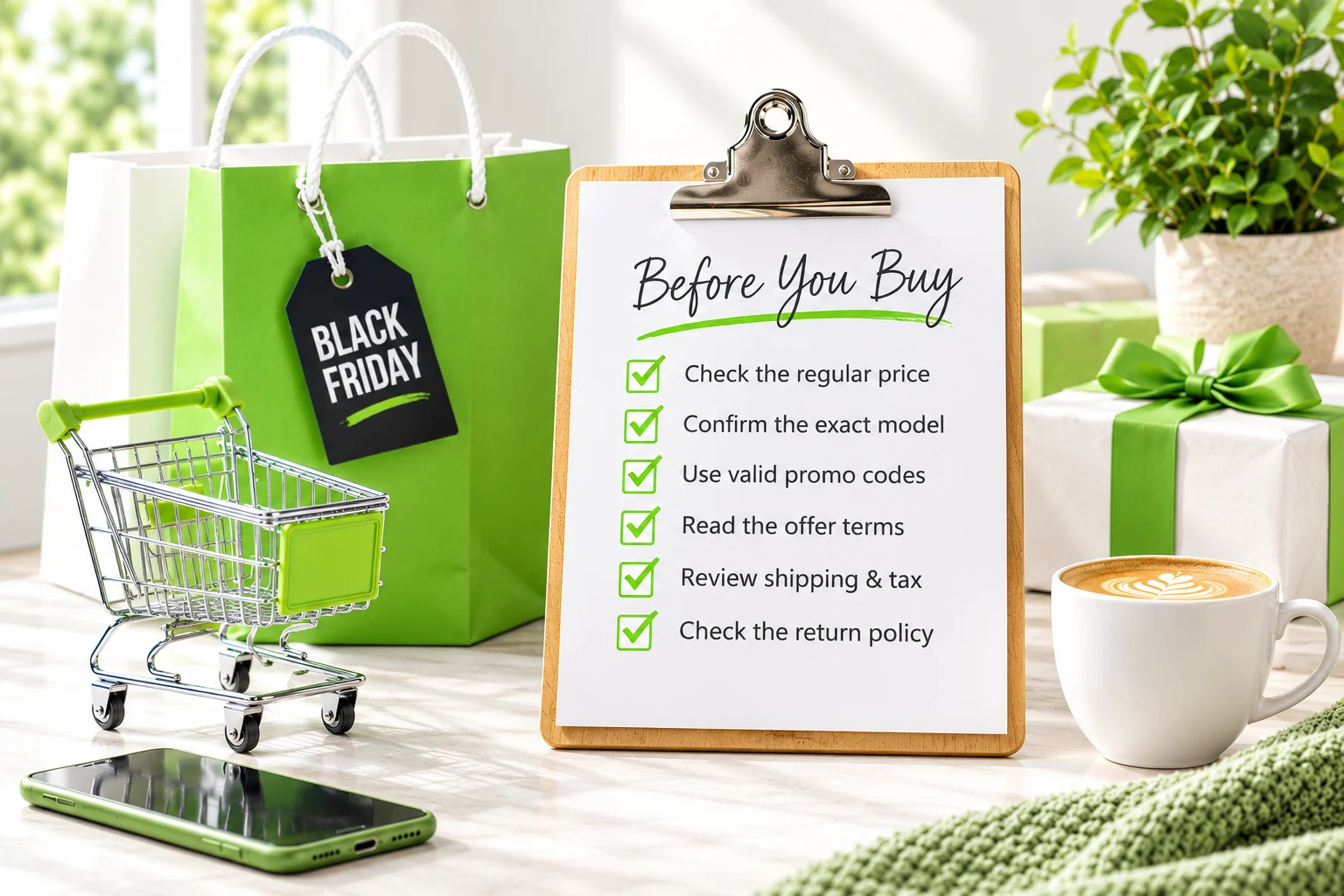
Before you buy anything on Black Friday, confirm six things:
- The item is something you actually planned to buy.
- The “sale” price is lower than what you’d normally pay.
- The exact model or version is the one you want.
- A promo code or other offer isn’t available to lower the price further.
- The final total, including shipping and tax, is still a good deal.
- The return policy covers you if something goes wrong.
The rest of this guide explains how to do each check quickly.
Before the Sales Start: Set Yourself Up
Most Black Friday regret comes from decisions made in a hurry. A little preparation removes most of the pressure.
Make a short list and a budget
Write down what you actually need or want, with a maximum price for each item. A list protects you from impulse buys, which are the fastest way for a “saving” to turn into extra spending. If a deal isn’t on your list, ask whether you’d have bought it at full price. If the answer is no, skip it.
Record the regular price now
Note what your target items cost today, before sale season ramps up. Retailers often show a “was” price, but that reference price isn’t always one shoppers really paid. Your own record is the most reliable comparison you’ll have. A browser price-history tool can also help, though it’s worth treating its data as a guide rather than a guarantee.
Browse the big deals in advance
Looking over current Black Friday deals ahead of time shows you which retailers are discounting what, so you can spot a genuinely strong offer when it appears.
The Core Checklist: Verify the Deal
1. Confirm the discount is real
Compare the sale price against your recorded regular price, not the crossed-out number on the page. A product marked “40% off” might simply be returning to its usual price. If you can, check two or three other retailers selling the same item.
2. Check the exact model
Some products are sold in special sale-season versions that differ from the standard model, with different specs, materials, or features. This is common with electronics and appliances. Match the full model number, not just the product name, and check the storage size, screen size, or capacity listed in the description.
3. Look for a promo code or stackable offer
Before you pay, check whether a coupon or promo code applies on top of the sale price. Some retailers allow codes on already-reduced items, and some don’t. The terms will tell you. Our guide to Black Friday promo codes explains how codes work in more detail, but the quick habit is simple: try a code before you check out, and read the exclusions.
4. Read the fine print
Look for the following, usually listed near the offer or in the terms:
- Minimum spend requirements
- Excluded brands or categories
- Offer start and end dates
- Limits per customer
- Whether the deal is online-only, in-store only, or both
- Whether the discount applies at checkout or through a rebate you must claim later
5. Calculate the real total
Add shipping, taxes, and any fees to the sale price. A low item price with expensive shipping can cost more than a slightly higher price with free delivery. If a retailer offers free shipping above a certain spend, check whether the threshold pushes you into buying something you don’t need.
6. Check delivery timing
If the purchase is a gift, find the estimated delivery date and compare it with when you need the item. Shipping can slow down during peak shopping periods, so a cheap deal that arrives late isn’t much help.
7. Read the return and exchange policy
This is the check most shoppers skip. Return windows, restocking fees, and condition requirements vary by retailer and sometimes by product category. Some stores extend their holiday return window and some don’t, so confirm the policy for the specific item on the retailer’s own website. Pay particular attention to final-sale labels, since those items usually can’t be returned.
8. Confirm the retailer is trustworthy
If you’re buying from a store you don’t know, look for a clear business address, contact details, and visible policies. Be cautious if a price looks far lower than every other seller’s. Unusually deep discounts on in-demand products can be a warning sign.
A Quick Reference Table
| What to check | Why it matters | Where to look |
|---|---|---|
| Regular price | Shows whether the discount is real | Your notes, other retailers, price-history tools |
| Model number | Avoids lower-spec sale versions | Product page and specifications |
| Promo codes | May lower the price further | Coupon pages, retailer emails, checkout |
| Offer terms | Reveals exclusions and limits | Offer details or terms link |
| Total cost | Includes shipping and tax | Cart and final checkout page |
| Return policy | Protects you if the item disappoints | Retailer’s official policy page |
A Realistic Example
Say you want a pair of wireless headphones. You noted the usual price a month ago. On Black Friday, a retailer lists them at a visible discount, and the product page looks great.
You compare the model number and find that the sale version is an older edition. Another store has the current model at a slightly higher price, plus a promo code that brings the total close to the first store’s price, with free shipping. The “bigger” discount wasn’t the better deal. That kind of difference only shows up when you follow the checklist.
Common Mistakes to Avoid
- Buying because of the percentage. A big percentage on a product you don’t need is still money spent.
- Ignoring the price before the sale. Without a baseline, every discount looks impressive.
- Skipping the code box. If a retailer allows codes, it’s worth a quick check.
- Missing the end date. Some offers end earlier than the main sale does.
- Overlooking shipping and handling fees. They can quietly cancel out a discount.
- Forgetting return policies. A great price isn’t great if you can’t return a faulty item.
- Buying from too many stores. Multiple shipping charges and separate return rules add up.
Practical Tips to Save More
Compare, then decide. Open a few tabs for the same product before committing. A two-minute comparison can reveal a meaningful difference.
Spread out your shopping. Not every product reaches its lowest price on the same day. Learning about timing purchases to save can help you decide which items to buy right away and which to wait on.
Use wishlists and alerts. Many retailers let you save items and notify you of price changes, which saves you from checking repeatedly.
Keep your order confirmations. You’ll want them if you need to make a return, claim a rebate, or ask about a price adjustment (policies vary by store).
Pay with a method you trust. Use a payment option that gives you dispute protection, and avoid entering card details on pages you haven’t verified.
Frequently Asked Questions
When is Black Friday in 2026?
Black Friday is on Friday, November 27, 2026, the day after U.S. Thanksgiving. Many retailers begin offering deals earlier, sometimes weeks ahead.
Is everything cheaper on Black Friday?
No. Some products see their best prices of the year, while others are discounted just as much at other times. That’s why recording regular prices beforehand is so helpful.
Can I use a promo code on Black Friday deals?
Sometimes. It depends on the retailer and the specific offer, since many exclude sale items or certain brands. Check the terms and test the code at checkout.
How do I know if a Black Friday discount is real?
Compare the sale price with the price you recorded earlier and with other retailers. A “was” price on a product page is only one data point, and you shouldn’t rely on it alone.
Are Black Friday purchases returnable?
Usually, but it varies. Some items are marked final sale or have shorter windows. Always read the retailer’s return policy before you buy.
Should I wait for Cyber Monday instead?
It depends on the product. Some deals appear on both days and some are specific to one, so decide based on the item and how much you’d save by waiting.
Conclusion
A solid Black Friday shopping checklist comes down to a few habits: know what you want, know the regular price, read the terms, calculate the full cost, and understand the return policy. Each step takes only a minute or two, and together they keep you from paying more than you should or buying something you don’t need.
Before you check out on your next purchase, run through the checklist once, try a promo code, and compare the final total. Browse our current Black Friday deals to see what’s available and plan your list around what’s actually worth buying.


