
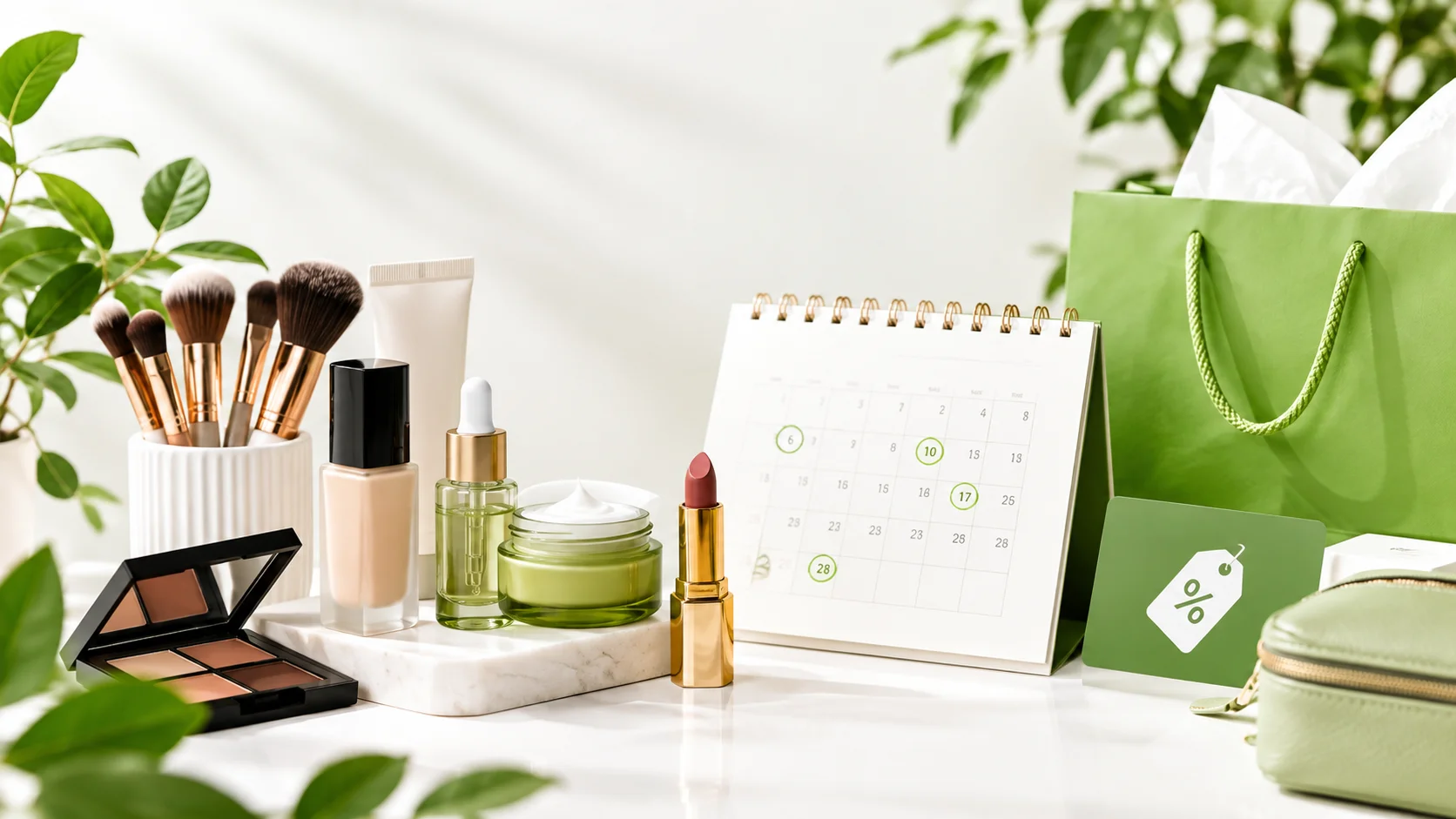

Beauty products rarely go on deep discount at random. Skincare, makeup, and hair care brands follow a fairly predictable sales rhythm tied to specific months, retailer loyalty events, and holidays. If you've ever paid full price for a serum only to see it marked down weeks later, timing — not luck — is usually the difference.
This guide breaks down when beauty deals actually happen throughout the year, why certain months are better than others, and how to combine sale timing with coupons to get the lowest possible price.
The Short Answer
The best times to buy beauty products are during the two major retailer sale windows — spring (typically March–April) and fall into the holiday season (October–December) — along with early-year clearance in January, when past-season packaging and holiday gift sets get marked down. Big-box beauty retailers like Ulta and Sephora also run their own recurring loyalty sales roughly twice a year, and these tend to offer the deepest discounts of any point in the calendar.
If you only shop beauty sales twice a year, the fall/holiday window and one retailer loyalty event are the two that matter most.
How Beauty Sales Are Structured
Unlike apparel or electronics, beauty retail discounts come from a few repeating sources:
- Retailer loyalty sales. Ulta's 21 Days of Beauty and Sephora's Savings Event are the two biggest recurring sales in U.S. beauty retail. Each one runs roughly twice a year — Ulta's event has historically landed in March and again in August/September, while Sephora's has run in spring and again closer to the holidays. Discounts are usually tiered by loyalty status, so members in a retailer's top rewards tier get first access and the biggest percentage off.
- Seasonal and holiday sales. Black Friday and Cyber Monday bring some of the steepest markdowns of the year, especially on gift sets and limited-edition holiday packaging. January and early February often bring clearance on that leftover holiday inventory.
- Brand-specific sales. Individual brands run their own promotions, often tied to product launches, brand anniversaries, or seasonal collections, separate from retailer-wide events.
- New-product cycles. When a brand refreshes packaging or formulas, older versions of a product are frequently discounted to clear shelf space, even outside a formal sale period.
A Month-by-Month Look
| Time of Year | What's Usually on Sale | Why |
|---|---|---|
| January–February | Holiday gift sets, past-season packaging | Post-holiday clearance |
| March | Skincare, makeup, hair care (retailer-wide events) | Spring loyalty sales |
| May–June | Sunscreen, self-tanner, body care | Early-summer promotions |
| August–September | Full-catalog markdowns across categories | Fall retailer loyalty events |
| October–November | Gift sets, fragrance, tools | Black Friday and Cyber Monday |
| December | Clearance on holiday-exclusive items | Post-holiday markdown |
Exact dates shift slightly every year, so it's worth checking a retailer's loyalty program page or a coupon aggregator close to the season you're shopping in rather than assuming last year's calendar repeats exactly.
Important Things to Know
- Loyalty tier matters. At retailers like Sephora and Ulta, the size of your discount during a sale event is usually tied to how much you've spent with them, not just whether you're a member. Free membership tiers still qualify for a sale, but often at a smaller percentage than top-tier members.
- Exclusions are common. Some brands opt out of retailer-wide sales entirely, and gift cards typically aren't eligible for percentage-off promotions.
- Stacking has limits. Retailer sale discounts don't always combine with every manufacturer coupon or promo code — check the fine print before assuming discounts stack.
- Limited-time doesn't mean limited-stock. Popular items can still sell out mid-sale, so if you're after a specific product, don't wait until the last day of the event.
Practical Tips to Save More
- Sign up for loyalty programs before the sale starts. Tier status is usually locked in before a sale begins, so joining mid-event won't unlock a bigger discount.
- Check for a promo code before checking out. Even during a storewide sale, an additional stackable code can sometimes shave off a few extra dollars or add free shipping. Browsing available makeup coupons and deals before you buy takes a few seconds and can catch a code you'd otherwise miss.
- Buy staples during sales, not launches. Save your sale budget for products you already know you'll repurchase, and buy new launches at full price only if you want to try them right away.
- Watch specific brands, not just retailers. If you're loyal to one or two brands, follow their own promotional calendar in addition to the big retailer events.
- Time bigger purchases around the retailer's biggest event of the year. For most people, that's the fall sale that leads into the holiday season — it tends to include the widest brand selection.
For a broader look at how sale-timing strategy applies beyond beauty, see this guide to best times to shop and save.
Common Mistakes to Avoid
- Buying gift sets right when they launch. Holiday sets are often released weeks before Black Friday, at full price. Waiting can mean a lower price on the exact same set.
- Assuming every brand is included in a storewide sale. Some high-demand or newly launched brands sit out major sale events.
- Forgetting to check return policies on sale items. Some sale purchases carry different return windows than full-price items.
- Stockpiling products with a short shelf life. Skincare with active ingredients (like certain serums) can degrade before you use it up if you buy too much at once, even at a good price.
Example
Someone shopping for a mid-range moisturizer might pay full price if they buy it in June, but the same product is likely to appear in a fall retailer sale at a percentage off, and again in a post-holiday clearance markdown in January. Waiting for one of those two windows — rather than buying on impulse — can mean a meaningfully lower price for the identical product.
Frequently Asked Questions
Is it better to buy beauty products online or in-store during a sale?
Both usually carry the same discount during a retailer-wide event, but online shopping makes it easier to apply an additional promo code and compare prices before checkout.
Do beauty sales apply to every brand?
No. Some brands, particularly newer or high-demand ones, may be excluded from storewide percentage-off promotions even during a major sale event.
Should I wait for Black Friday to buy beauty gifts?
If you're buying gift sets or fragrance, Black Friday and Cyber Monday are typically strong options since gifting-focused inventory sees some of the year's biggest markdowns.
How do I know if a promo code will stack with a sale?
Check the code's terms at checkout. Some retailers exclude sale items from additional promo codes, while others allow stacking on top of storewide discounts.
Is skincare cheaper at a different time than makeup?
Not usually — most retailer-wide sales discount skincare, makeup, and hair care together. Category-specific deals (like sunscreen in early summer) are more the exception than the rule.
Conclusion
Beauty sales follow a repeatable pattern: two major retailer loyalty events roughly six months apart, a strong holiday sales window, and a post-holiday clearance period. Knowing that rhythm lets you plan bigger purchases around it instead of buying at full price out of impulse. Before you check out — sale or not — it's worth a quick look for an active coupon or promo code that can add a little extra savings on top of whatever discount is already running.


